Friday, 9 September 2022

CO2 capture in a small brewery – a case study


The UK’s small brewers (those producing below 100,000 HL/yr[1]) account for the production of approximately 215 million litres of beer, at an average ABV of 4.6% (3.65% ABW)[2]. Taking into account fermentation vessel (FV) losses (10%), stoichiometry[3] informs us that the total amount of CO2 produced by this fermentation is: 

1.1 x 3.65% x 0.9565 x 215 = 8.26 million kgs, or 8,260 metric tonnes (t), or 0.038 kg/l. 

Until very recently, all of this was vented to the atmosphere.               

Of this beer, around 100 million litres are packaged flat, into cask[4]. Therefore, 115 million litres of small brewery beer is carbonated, and, whilst some of this will undoubtably be carbonated via a spunded fermentation, the vast majority will rely on liquid CO2 purchased on the wholesale market, not only to carbonate the beer, but also to back pressure vessels and fillers in order to prevent that carbonation from escaping. 

Bottling, canning and kegging in small brewery packaging facilities typically uses up to 0.05 kg per litre to carbonate the beer and run the filling machines[5]. Therefore, as an industry, we are on the one hand releasing 8,260 t of CO2 into the atmosphere as a result of fermentation, and, on the other hand, purchasing 5,750 t of CO2 from the wholesale market to put back into the beer. In the days of plenty, marrying these two CO2 streams up (one out, the other in) via technology wasn’t considered worth the hassle, despite the engineering being already fully available (albeit in a macro form). Recent price rises in wholesale liquid CO2 (and a couple of industry-wide droughts of the stuff) have changed the dynamic; two firms have entered the market, seeking to provide a solution that matches up this supply with the demand, by capturing the evolved CO2, rendering it fit for use and liquidising it for storage and transport. Earthly Labs, based in the US, have developed a CO2 recovery unit for craft brewers above the 15k hl/yr scale, and have some units operational in the US. Dalum Beverage Engineering from Denmark have developed a unit suitable for brewers producing 5k+ hl/yr scale, of which there are two already operational in Denmark, a third recently installed at GADDS’ The Ramsgate Brewery in the UK, with more units on their way to the Faro Islands, Norway, Bristol and beyond. This paper is an attempt to explain the principles and reality of capturing fermentation-evolved CO2 from a small brewery, and transporting it to a craft drink packager for reuse, in place of wholesale gas.


The installed system consists of collection pipework, a foam trap, the capture unit and transport/storage vessels.


Collection

CO2 is collected from closed FVs via the CIP arm. Following the lag phase, active fermentation clears the vessel headspace gas (air) and the O2 content is monitored via a handheld unit held at the CIP arm. Once below 0.6%, the collection can begin. The CIP arm is connected, via a 1-inch braided hose, to a manifold leading to a 1-inch collection main, a PRV (in case of unit failure) and a foam trap. The system is designed to operate at 0.25 bar, a low enough pressure not to trouble the yeast or flavour profile of the beer.


O2 monitoring

From the foam trap, the CO2 enters the capture unit and is now monitored for O2 content by the unit. Should the O2 content stray above 0.6%, the gas is vented until O2 levels lower. In reality, oxygen levels in evolved fermentation gas fall to below 0.6% within a few hours and don’t increase thereafter.


Low pressure scrubber

The gas enters the base of a 3m tall, narrow cylinder filled with surface area busting stainless steel pall rings. Cold water is trickled down the column as the gas makes its way up it. Here, alcohols, esters and other impurities are picked up by the water (thereby separating them from the gas) and the resultant effluent is collected as a ‘grey’ water supply.


Compression

On leaving this column, the clean gas runs through a solids filter and onto a 3-stage compression process, with intermediate cooling and water removal stages. The Dalum designed, oil-free, variable speed, single stroke, 3-stage compressor is right at the heart of the unit. Gas is compressed to 35 - 45 bar in the multi-cylinder piston chamber, regulated to 60°C, and the moisture removed is collected as grey water. Between stages 2 and 3, the gas passes through a high-pressure sulphur scrubber.


Dehydration

The dry gas, now at ambient temperature and high pressure, passes through a column containing inert aluminium oxide desiccant, for super drying. The degree of dryness of a gas can be expressed in terms of the dew point – the temperature at which, under constant pressure, the gas has 100% humidity. The lower the dew point, the drier the gas. On exiting the dehydration columns, the CO2 has a dew point typically of -60°C.


Rectification/liquefaction

At 35+ bar, the super dry gas now only requires cooling to 3 or 4 °C to liquify and enters a Dalum designed glycol cooled condenser, and on to a reboiler. Constant boiling releases O2 molecules from the liquid phase CO2, which migrate back through the condenser and are vented off periodically. Purified, liquid CO2 collects in a small tank at the end of the system and is pushed into 240 litre transport vessels.


Collection, storage and transportation

The brewhouse at GADDS’ produces 26 hl of wort per brew, fermented in either single or double batches under a top pressure of 0.25 bar. After a lag phase of around 8 hours, a single fermentation will evolve gas with an oxygen content below 0.5% and at a rate of 1.5kg/hr for approximately 48 hours. A handheld O2 monitor lets the brewers know when to hook up the fermentation to the collection system (generally 16 hours from yeast pitching). Some CO2 is lost through the initial stage of fermentation, due to high O2 content, and some remains in the beer at the end. With good management, 75% yields have been achieved, with an oxygen content of <6 ppb, measured with an Orbisphere (wholesale liquid CO2 at the bottling site measures 20 ppb O2). A burette is used to demonstrate purity >99.99%.


The vacuum insulated transport tanks, mounted on a skids with casters, and equipped with internal vaporisers, are used to store and transport the collected gas to the bottling site. Under the ‘small limit’ threshold of 1000kg for CO2, these can be transported legally without any onerous specialist safety equipment.

Once off-loaded at the bottling site the tanks are connected to the CO2 systems simply via a standard 3/8-inch line and a secondary regulator. Due to the high quality, this recovered gas is reserved for carbonation rather than providing back-pressure in vessels and fillers.


Review

This compact unit has a footprint the size of a pallet, but delivers a game-changing service to the small brewer. The engineering is inspired, and the quality of the build first class. This isn’t a noisy machine; it sits and rumbles quietly, hissing every now and then to let you know it’s still working. And though reliability is excellent, you won’t get the best out of the unit unless you make the effort to engage with the principles, learn to drive it, and flex your collection system to suit. This is all well within the reach of the practical brewer, and there’s a handy remote management system that records and rewards your efforts. In the interests of balance, I’m desperately trying to find something negative to say about this, but I can’t. In my opinion, as an engineer turned brewer, this is awesome.


[1] This report is primarily about technology that has recently become available to the smaller brewers – it has been available to those brewers above 100k HL for some years.

[2] SIBA Members Survey 2021

[3] Balling, Carl. J. N., Die Bierbrauerei. Verlag von Friedrich Temski: Prague, CHZ, 1865. 

[4] SIBA Members Survey 2021

[5] South East Bottling internal audit. 

Friday, 12 August 2022

Carbon capture in a small brewery


Very funky engineering

Brewing beer involves the fermentation of sugars (from malted barley) by yeast, producing alcohol, and carbon dioxide (CO2) which is largely vented off to the atmosphere. The very largest brewers, your Heinekens and your Molson Coorses, have huge great bits of equipment that capture this CO2, purifying it and condensing it into a liquid form they can then use for the kegging, canning and bottling of the beer. The smaller brewer, however, cannot capture this CO2 and must let it go, and then, in a cruel twist of circumstance, buy liquid CO2 to put back into the beer and to run the kegging, canning and bottling machines. Crazy eh?

But not for much longer. A genius Danish engineer, Kim Dalum, has successfully miniaturised the CO2 capture technology for use in smaller breweries, and the very first one in the UK is here at GADDS’, undergoing full sea trials.

To give you an idea of the scale of the CO2 given off during fermentation – here at GADDS’ it accounts for around 25% of our carbon footprint. We’re hoping to capture 2/3rds of this, reducing our fp by 17% in one go. We then sell the purified CO2 to our bottling company who will put it back into our bottled beers, reducing their footprint at the same time. Our aim is to prove the technology and concept, and then show other small brewers how it can help them, and their footprint.

Back the engineers, they have the answers.


The purity is very high indeed - this showing 16 parts per billion oxygen, which is better than most CO2 on the wholesale market.


Friday, 22 July 2022

Solar update

Our current electricity rate is about 15 pence per kWh, ignoring the daily standing charge.

The solar array cost us £13,000.

Therefore once the solar array has produced 13,000 / 0.15 = 86,700 kWh (86.7 mWh) it will have paid for itself.


It's cloudy today.

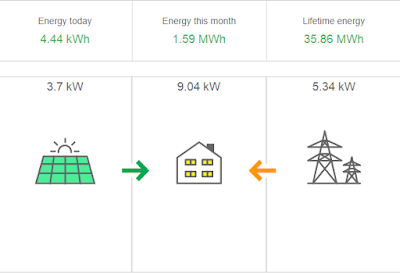
28 months after installation the array has produced 35.85 mWh, or 41% of target, suggesting that, in a further 40 months time, pay back will have been made in full (in a total of 5.7 years). 

Of course, this doesn't take into account the fact that the current rate of £0.15/kWh will at least double when our pre-crisis contract runs out early in 2023. If we factor this in payback will be achieved in 25 months time, a total of 53 months (4.4 years) from installation.

These are 20 year panels, giving us 15.6 years of totally free electricity, and given the present direction of travel, that is going to be worth a substantial amount of savings.

One of our better investment decisions.

Monday, 28 March 2022

Road to Net Zero - Chapter 1

Here's a thing: fermentation produces heat, and if we didn't dissipate that heat the beer would be rubbish, so we use electricity to run refrigeration plants that chill glycol and pump it around jackets on the fermentation vessels, taking the heat away. When the ambient temperature is low, such as in the winter (or at night) the chillers don't need to work so hard, and so draw little electricity, and, conversely, when the ambient temperature is high, such as when the sun shines, the chillers work harder, drawing more electricity. Happily for us this matches electricity production from solar panels - they produce more in the daytime, and in the summer, than they do at night time, and in the winter. In 2020, just as the world locked down, we installed 45 solar panels on the roof of the brewery, and we now have some data to analyse their contribution.

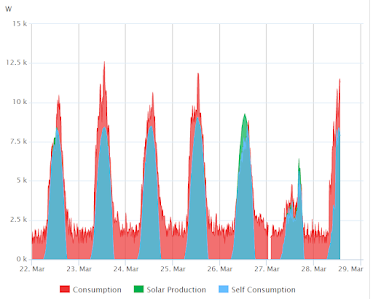
The above graph shows the last 7 days, starting with Tuesday 22nd. The red area is consumption, and you can see how we have a base level of around 2 kW during the night, rising up to over 10 kW on most days as the chillers work harder. The extra tall spikes on Mondays, Wednesdays and Fridays are from the cask washer.

The blue area is solar production and it's plain to see that it's well matched to consumption. Green denotes times when production exceeds consumption and the excess goes into the grid. In the last 7 days we've consumed 627 kW hours, producing 57% of that ourselves.

If we're paying 15 pence per kWh, we've saved £53.60 in a week. The total project cost was £15k, so you can see payback is going to be around 8 years at today's prices. 

We're currently doing some feasibility work on a solar roof for the warehouse - it's a chilled space, and so there should be a good match there, but it's also used to charge the fork lift truck, a motorised pallet truck and a delivery van, and, since these activities occur mainly at night, their consumption won't match solar production unless we invest in a battery system, or rethink our habits. Once we have some data on consumption I'll share it with you.


Friday, 4 February 2022

Happy Birthday Old Friend


 I find it hard to believe, but the records confirm it - we've been brewing GADDS' Number 3 Premium Kentish Pale Ale for 20 years. In February 2002 I concocted a very simple pale ale using a high quality pale malted barley variety, and the very best hops I could find, East Kent Goldings. I can still vividly remember my first pint, how it tasted, and how I felt (pretty chuffed). The recipe hasn't changed ever since.

Here's some fun facts about GADDS' Number 3:

  • It was first brewed in the Royal Harbour Brewhouse and Bakers - we'd spent 18 months restoring this derelict restaurant on Ramsgate Seafront that later went on to become the Belgium Bar, the Green Tara and now the Ramsgate Market.
  • Our first customers were The Artillery Arms, The New Inn (Minster) and The Grange. 
  • In June of 2002 the we sold casks of Number 3 to the Montefiore Arms for the first time. The price was £55 each, plus vat.
  • Number 3 won 'Best Beer in Kent' in 2009, and 5 times after that, and was runner up Champion Beer of Britain in 2017.
  • I originally wanted to call it 'East Kent Gold', but was out voted by my fellow founders - both mathematicians, they felt simple numbers would allow the beer to do the talking. I can't argue with that.
Help us celebrate by voting for Number 3 in the Taste Of Kent Awards, and then reward yourself with a case or two of Number 3 from the shop, using the well deserved "ILOVENO3" code at checkout for a handy 20% discount*.

Cheers!
The GADDS


*one use per customer, ends 28th February 2002.

Sunday, 21 November 2021

Trouble Brewing

From time to time we need to talk about beer duty, one of the taxes that Her Majesty's Treasury applies to our fun, adding between 20 and 55p to a typical pint. We're happy to pay it, safe in the knowledge that the money raised is used to help fund social necessities such as schools and hospitals, and that the progressive system, introduced 20 years ago, is fair, with the most able (the multinational breweries) contributing the most.

However, as you may have read last year, plans have been drawn up by government to overhaul alcohol duties as a whole, and beer duty in particular. What you won't yet have read about are the implications of these changes, and that's what we need to talk about.

The calculation of beer duty isn't difficult, but it is boring, so I've done it for you. This is what it means for your regular pint, whether that's a beer from a small brewery such as GADDS' Number 5 Best Bitter,  a beer from a medium sized brewery such as Pig's Rump Best, or a beer from a massive multi-national corporation such as Green King Best. 

Small brewery beer duty will rise from around 24 to 27 pence per pint. Taking into account the pub's margin and vat, you'll likely see a rise of 8 pence a pint at the pumps.

Medium sized brewery beer duty will fall from 36 to 31 pence a pint, and you'll see the price at the pump drop by about 14 pence.

And mega-corp beer duty will also fall, from 48 to 45 pence leading to drop at the pumps by around 7 pence.

You'll have noticed that the largest, and the medium sized, brewers are to see a lowering of their duty liabilities, and you'll have noticed too that it's the smallest brewers paying for this. Why would the government do this? I honestly don't know, I've heard all the reasoning and none of it stacks up to scrutiny. Private Eye think they have a clue though:


Private Eye, September 2020