Showing posts with label technical. Show all posts

Monday, 8 June 2009

English Reserve

So I've blathered on a bit about barley wines and oak aging over the last couple of months and quite naturally you're getting fed up, wondering where the hell this beer is. Wonder no longer. It's in the Shop as I write, all labeled up and on sale.

Now don't be expecting a beer you can guzzle down in 5 minutes: dig this groovy one in small quantities, late at night, after you've finished operating heavy machinery. I had it with a rich beany stew and new potatoes last night and it were, well, spot on.

This beer has spent 30 days resting in a Rondo 2005 french oak cask from the mighty Chapel Down vineyard in deepest Kent, absorbing fine qualities from the red wine infused wood. If it's a regular beer flavour you're after you've arrived at the wrong place. However, if you adventure fearlessly in the flavour world, step right this way......

Friday, 3 April 2009

Layering


Sometimes it's good to layer flavours. Last month I brewed our barley wine and got some nice malt, a little toffee (roast barley and chocolate malt make toffee), some lovely red berry notes from the rye and a deep bitterness from our hops.

Then I stored it on bed of 'Bramling Cross' hops to extract some light, fresh green notes for contrast.

Today we split the brew: half into french oak casks from the splendid chaps at Chapel Down Vineyard (big thank you to Frazer and Owen - there'll be a case for you when it's done) and half into another tank liberally dosed with a new variety of hop called NZ Nelson Sauvin. The former aliquot ought to gain vinuous undertones with perhaps a little oak and tannin, the latter, massive fruit and grapes if the early taste of these hops is anything to go by.

So at the moment we have two beers maturing, ready for bottling 'TBC', according to taste.

Layering is very much in this season.

The first few hours....(after the 'lag')

FV 3 - 08.00hrs 3rd April, 2009

As fermentation begins, bubbles of carbon dioxide rise to the surface accompanied, a few hours later, by fresh yeast cells, hitching a ride. The resulting plume is fungal in form and is superseded a few hours later by a more creamy texture. Whilst I hope my Nokia 6500 classic can do justice to this wonderful example of natural mathematics, technology has yet to provide a transducer capable of communicating aroma. It's all lemon, grass, mint and spice (clove) this morning.

Brewer's privilege. And lets face it, endless free ale apart, we get very few of those.

Monday, 30 March 2009

Cask Watch


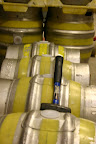
The containers we use to get our beer to the pub, and from which the beer is sold are called 'casks'. They're made of stainless steel and cost a significant amount. We need a surprisingly large number of them, typically around 7 to 8 times the number of casks we sell in a week; we need a week's stock for filling, two week's stock for maturing, two week's worth in the pub and a week to get them back. Add in a week or two for flexibility and there you go, hundreds of casks, many thousands of pounds of capital.

Being stainless steel they have a variable scrap value depending on the demand so we must be vigilant keeping tabs on them. Notice the colour banding? Each brewery in the country retains their own 'population' and has them colour coded for ease of recognition. They're all individually numbered - pressed into the steel permanently. The owners name is similarly embossed round the rim, or chime. And they're bar coded and scanned where ever they go.

We still bloody lose some though so if you come across a BBQ with 3 yellow bands, do give us a shout - it's worth a beer or two!

Thursday, 19 February 2009

GADDS' Number 1 Barley Wine


By mixing malted barley with brewing liquor (water treated with salts and acids) we create a porridge like infusion called a 'mash'. Enzymes in the malt quickly go to work converting the cereal starch into simpler sugars such as glucose and fructose. Later, brewers' yeast will metabolise these sugars into alcohol.

You'll have deduced by now that the strength of a beer is reliant upon the amount of malt employed to brew a fixed amount of it. The above photograph shows the mash tun as it is just at the moment: filled to the absolute brim. More full in fact than it has ever been before. The majority is a quater tonne of pale malted barley but there is some crystallised malt, a little roasted barley, some chocolate malt and a judicious weight of crystallised rye in there too. We're brewing a barley wine, already titled 'GADDS' Number 1' and as yet of indeterminate strength.

More on that later.

Like I said, it beats working for a living.

Wednesday, 18 February 2009

HSSOS1


Say hello to our new addition, HSSOS1. It's a rather large in-line hop-seed strainer suitable for a brewhouse 10 times the size of ours. Cunningly, I'm going to fill it with fresh hops and pump beer through it, completely reversing it's design use.

Hops contain an extraordinary amount of flavour compounds and by using them in different ways we extract different attributes. Tomorrow I'll brew a barley wine and look to get some peppery spicy notes by using the HSSOS1.

Well it's better than working for a living.

Note to competition - this was the last one and getting one fabricated will cost more than you're prepared to pay. You can borrow this one though if you like.

Sunday, 1 February 2009

CCV YP01 - welcome aboard.


A new vessel arrived on Thursday last week - it'll be pressed into service as a part of a yeast propagation system just soon as I find the various bits that I think I still need. This shiny newcomer hails from the North and I've rather taken to it already.

Wednesday, 28 January 2009

Grain pain - epilogue.


This photo of the mash tun plates shows quite clearly the source of yesterday's troubles - the gap should not be a gap. And the plates should be horizontal too...

All fixed and this morning's 'run-off' is going smoothly once again. 'Great Scot!' has proved more popular than I imagined a peaty pale ale could, so we're brewing it again. You'll remember I tweaked the recipe to get a little more hop and a little less Lambert & Butler? Well it seems to have done the trick - isn't it nice when that happens?

Tuesday, 27 January 2009

Grain pain.

The usual rhythm of the brewing process has been disturbed by leaking mash tun plates passing grain, as you'll clearly appreciate from this photo of the wort collection sight glass.

It's a minor annoyance in the grander scheme but things run best when they run smooth and that applies to this little beer making contraption that I call a brewery, more than most. I don't know the precise cause yet but I suspect I'll find a small plastic riser (er, a raw plug pressed into action the last time this happened, about 3 years ago) slightly out of place when I clean the tun. Grrrr.

We don't want grain in brew; the husks contain polyphenol material that will cause haze problems and possibly a slightly harsh flavour. I'll finish collecting the wort in 9 minutes time, leave the copper to stand for a further 9 and then tap off a gallon from the base of the vessel. This ought to remove much, if not all, of the errant cereal, rendering this batch serviceable.

Monday, 26 January 2009

RAMSHEAD rtm


Phew. Well done HandsomeIP and many thanks.

Consider this as an endorsement of their fine work and a recommendation for anyone having IP issues.

Sunday, 12 October 2008

Fall Out

The alcohol industry attempts to self regulate in the matter of responsible marketing and the self regulators self appointed to regulate myself are the Portman Group. They basically want to ensure labels and packaging don't promote alcohol misuse and, from their complaint decision history you can see they're generally pretty fair about things. Some of the plaintiffs, however, are clearly bonkers; check this and this.

This subject came up last week regarding Orkney Brewery's strong ale, 'Skull Splitter'. It's a complicated case; the beer has been around considerably longer than the regulatory code, the name refers to an historical, local figure and the market within which it is sold is dominated by the beer(ded) connoisseur rather than the homicidal maniac.

In the old days we used to produce a very strong ale called 'Earth Stopper' but I don't suppose it'd be a sensible name these days. And nor is 'Fall Over', despite the reference to the end of Autumn and the relatively low abv. So I'm not going to use it. It's banished to the bin of poor taste and irresponsibility for ever.

It wasn't very funny or clever anyway.

No Tomorrow, however, is oblique enough to escape.......

Sunday, 5 October 2008

Outside influence

November's special is going to be an american style winter warmer named 'Fall Over' (geddit?) and, never having brewed this kind of beer before, I drafted in help in the form of P & S, a couple of well traveled brewers/geeks/writers. The three of us convened in the brewery for a rare Saturday brew yesterday armed with bags of Willamette hops from Oregon (yes, the USA) and a couple of sacks of coloured malt new to me, 'aromatic' and 'melanoidin', German & Belgian respectively.

The brew went well and for a dyed in the wool brewing loner such as I am, I thoroughly enjoyed not only the company but the influence these two chums brought to my tuns. 'Fall Over' is in the can, fermenting away, and smelling gorgeous. It's a real departure from my normal style and I sincerely hope you're going to approve. If you pop in in the next couple of days I may even let you have a sniff.....

Wednesday, 17 September 2008

Down Hopping in Kent

The history of hop picking and migrant East London workers is long, rich and fascinating. I highly recommend the student to Hilary Heffernan's 'Voices of Kent Hop Gardens' for a first rate collection of primary source evidence. And for the more Marx-friendly, try Derek Bright's account of rural conflict and strikes. Of course those days are largely over, what with automation and er, a well organised, collective migrant work-force.

Anyway, it's the second week in September and we're slap bang in the middle of the hop harvest. I nipped out Monday morning to check on quality and progress down at Brooke Farm in Shatterling where Hunphrey grows our East Kent Goldings for us (the most very easterly grown English hops). Last year, and the year before, the crops were poor and there was a world-wide shortage, sending prices through the roof: prices to me rose from £5.50 to £35 per kilo at one stage. Worse than that was a shortage of real quality; luckily Kent grown hops were secured by yours truly good and early in the year so we've been fine, if a little more cautious, ever since.


It didn't stop blowing through this summer and on the hops it shows: see the brown bits? They're bruises from the poor flower getting a good battering. These won't win any awards this year but the nose is promising and the oils are looking good. We could end up with the best brewing quality we've seen round here for a few years, despite looking the ugliest. As for price, who knows? Well, no-one actually. The samples must be taken, in a few weeks time, and the world-wide harvest considered. Then the factors will roll their dice and who am I to call their bluff when they announce a 'small premium on this year's crop'?

Of course, the astute amongst you will know that we'll be limbering up to brew our Pale India Ale pretty soon.....

Thursday, 15 May 2008

Where's the Sunshine?

For some it's the sight of the first swallow and for others it's the Solstice but for me, the first day of summer is signaled by the first day of the Lords Test. Today in fact. (Even though rain has inevitably delayed the start of play).

And it is by happy coincidence that today I have begun to brew the first of this year's triptych of summer ales, Dr Sunshine's Special Friendly English Wheat Ale. First created by me & Scooly back in 2004 it is a mongrel cross-style between a Dutch Wit, an American Wheat and a light English Mild.

But what's it like?

Like nothing else. A high proportion of wheat in the mash provides a mellow soft base, spicy Perle hops a lovely fruity spicy middle bit with fresh ground coriander seeds & organic Valencia orange zest for some lovely citrus overtones.

Refreshing, one might say. I'll tell you more nearer the time.

Sunday, 4 May 2008

Sunny Days.

OK, now brewing beer is an energy intensive activity and always has been - we're never content with leaving stuff at ambient temperature, always wanting it very hot or very cold. So as a collective industry we've had a few hundred years practice at keeping these costs as low as possible. For instance: as the brew is boiling we use the steam generated to heat cold water for cleaning or brewing. Cooling the wort (after boiling) with cold water generates more hot water for cleaning or brewing or heating.

Yet despite all this efficiency and energy recovery our usage is relatively high so I took a look at the feasibility of installing a solar-panel (pv) system on our roof in the hope of becoming a British Gas supplier, rather than customer (which, as we all know, is close to purgatory).

Here's what I found out:
  • The south east is a good place to be for this kind of thing because it isn't the grim north, I suppose.
  • Our south facing roof, pitched at 30 degrees above the horizontal is a pretty good orientation.
  • Every 8 square meters of pv panels will generate around 800 units of electricity (based on our orientation & location).
  • Every 8 square meters would cost £5K installed.
  • 800 units, at current prices, saves me £73.44 on my British Gas bill.
  • The government would contribute a further £28 totaling up my savings to £101.44
So, for every £5000 I spend I save £101.44 per year. A return on investment (interest ignored) of 49.29 years.

Not exactly enticing is it? Would any manufacturer give me a 50 year warranty? Would they 'eckers like! Energy is going up and technology is improving so there will come a time when the numbers add up. If there emerged a vibrant pv panel manufacturing industry, costs would fall rapidly and grants and/or increased subsidy would help that become a reality sooner.

Lobby your MP please.

In the meantime I'm thinking up ways of integrating solar-water-heating-panels to our system as they are considerably more economically justifiable. Problem is, I have more hot water from my existing recovery systems than I really need already. Any ideas?

Tuesday, 15 April 2008

Exodus Update

Primary fermentation is complete and the green beer is sitting at room temperature, the yeast busy cleaning up some transitional flavours of fermentation I don't need (or desire). Tomorrow I will apply full cooling and the temperature will drop to cold over the following day. I'll leave it cold for a full further day during which much of the yeast will become dormant and settle on the flat bottom of the fermentation vessel, allowing easy separation by draining the young ale into a new tank, leaving the yeast cake behind.

On sampling today I noted an expected roasty aroma with a hint of sulphur. No hops on the nose but that doesn't surprise or disappoint me. I didn't want any. A very subtle hop note will emerge over the coming months; I used so many good hops it is inevitable and it will complement the roast, rather than over-power it. Promise.

In the taste it was a strong, almost grainy roast barley flavour followed lazily by a big, lumbering, momentous bitterness that runs through like a train, a very long train. After about 5 minutes you can't feel it anymore.

Great. All going swimmingly then. Don't worry about the bitterness, by the time you taste it this will be more a deep, distant rumble of a far away express than a next door freight, if you know what I mean.

The young and green Exodus 08 will be tanked for a few weeks to settle down, giving me time to check yeast levels are correct before casking.

Thought you might like to know.....

Saturday, 5 April 2008

Outside Chance

I got a free four hour consultation from a highly qualified and experienced food scientist the other day focusing mainly on traceability, record keeping and arse covering. They're all related of course, and documentation is a solid wall of defence. 'Some of our customers see it as a challenge to find something wrong' she explained (she works for a large company that sells groceries).

So I've added a little tick box to my brew sheet to indicate to the judge that yes, I'm not a complete moron and I did sterilise the fermenter before filling it. In the unlikely event that for the first time in over 5000 years experience a human pathogen successfully survives in beer, I'll be covered because I can show I ticked a box.

One more tiny moment, for one more tiny human is lost forever completing one more tiny but utterly pointless task. God strewth, we'll never get to Nirvana this way.

Actually it was quite an inspiring visit and I'm strangely enthused to create the most perfect record keeping system in the business.

Saturday, 26 January 2008

What is cask ale?

Good question and you've asked the right man.

When beer has finished its primary fermentation in bulk there remains in it a low level of yeast which is carried through to the cask. Residual, or additional, fermentable sugars are gently converted into alcohol & carbon dioxide over the next two or three days (conditioning or secondary fermentation) by this yeast which uses up any oxygen in the cask.

Thus the beer remains 'alive' and if crafted well, safe from spoilage. The flavour will develop over a period of time dependent upon the style and strength brewed. A light ale, for instance, would be at its 'peak condition' within a week and ought not to deteriorate for a couple of months. A true India Pale Ale, on the other hand, may not reach its best for 6 months and can last very soundly for a couple of years or more.

The process is exactly the same in bottle conditioned ale.

As you'll appreciate, such a fresh, live product needs tending properly and that includes storage temperature; too warm and the whole aging process accelerates unacceptably.


As the beer is drawn from the cask it is replaced with air and all the attendant spoilage potential of oxygen and air borne organisms. Thus the cask ought to be finished within three days of opening and the surrounding environment must be clean, as well as cool.

Looking after cask ale doesn't require a degree in rocket science but it does require care and attention, attributes you'd expect from the host of your local public house.

Monday, 21 January 2008

Testing Times

The recent cool spell has played havock with my bottle conditioning. You see yeast is a lazy beast really and won't get out of bed if the temperature drops below 12 deg C, as it has done for the last few weeks in the Brewery. Rather than try and keep the Brewery heated I took all the beer out of the cold store and left it out (plenty cool enough), turned the cooler off and put a heater, together with a few pallets of freshly bottled ale back in.

After a 'testing' weekend, I can confirm this tactic did the trick.


When they're properly ready with posh labels you'll be the first to know - why I might even invite you round to help me carry out the final 'checks'.

Thursday, 17 January 2008

Oatmeal Heaven

Yup, today was Oatmeal Stout Day!

I've never brewed one before and couldn't wait to get stuck in. Essentially, the history of OMS is to do with wholesome foods after the war and brewers were keen to get anything into their beer that allowed them to claim a health benefit for their product (is that too cynical?). They'd never get away with it today.

But crushed, malted oats (much like porridge oats) have a delicious, homely aroma and velvet smooth texture so I mashed 8 kilos in with 12 of roasted barley (black, burnt, coffee - think sooty chimneys) and 150 of pale ale malt and away we went.


Pity you can't taste or smell them - they're lovely. In fact, come round and get a handful!

I'll say no more for now but that all went well and I can almost taste the finished brew in my head. It'll be on special for February so I'll tell you more nearer the time........